Perhaps I jumped to conclusions, Dr. Bob, but upon hearing about your
upcoming eye surgery, my gut reaction was, oh
no, things are getting worse. However, as perspective started to set in, I
realized this operation could actually be the start of something better. That being said,
I don't think you'd much mind if I contemplated your condition, as you strike me as someone who is not necessarily
afraid to talk about death.
Perhaps I’m wrong, but it seemed to me that when I met with
you in person that one afternoon, you spoke of your worsening breathing condition
quite frankly, without being avoidant or despondent. That’s not to say you
sounded unaffected either- far from it. The passion for life shared by you and your
wife, Judy, practically exuded from the floorboards and burst out the front
door as I walked in. No, it seems to me that for you, the idea of death is like
a project you’d rather put off, but know you can’t delay forever (there's more on this topic from Dr. Bob himself at Dr. Bob's Bird Blog).
And so here I sit with the urge to write, which is
surprising considering I spent the last I-don’t-know-how-many hours staring at
my laptop working on the last paper of my bachelors degree. I’m not done yet,
but I put in some good work on it today, which is an improvement over the norm.
Paper or no paper, as my mind wandered back to your surgery, I knew I had
things to say.
So what exactly is it that’s swirling through my mind? I
guess it’s simply that I have a story to tell. It’s comprised of dozens of
different stories you and Judy told me while I was visiting, and also of those
things left unsaid. Unfortunately, I have a terrible memory when it comes to
stories, so I’d be surprised if I could repeat back more than bits and pieces
of any one of them. Still, I can capture the essence of my experience that day,
and say the unsaid things, because those are the things I never forget.
I was going to your house to retrieve a whole collection of
birding magazines. My dear friend Kevin had put me in contact with you, venturing
I might be interested in some of the cool things you were getting rid of as you
sorted through your belongings. You wanted to find someone who would appreciate
the collection and read the articles with a fervor and thirst for learning. I looked up your blog and read its most recent post. I was captivated right from the start, when you wrote the profound statement, "I am still the kid I was. Also I am still all the other ages I have
been. The brain is an amazing thing! We are who we are - and everyone we
have ever been - all at the same time." Well with this sort of philosophy, I knew it was to be one of those “meant” connections, an unexpected
meeting of the spirits in some other realm, only detectable here by the instant
feeling of knowing a person even when you don’t. And while I was excited
about the magazines, it was never really all about them. No, it was that root
force pulling me toward you that motivated me first and foremost. In fact, by
the time I was getting ready to leave your home, I had almost forgotten about
the magazines entirely.
After much postponing and delaying, I was finally on my way over. Cedar Waxwings greeted me from above your front door before Judy welcomed me in (I'm sure you'd agree, Cedar Waxwings are always a good omen). I entered the home and was met with an eclectic scene, warm and cozy and ordered in its chaos. This was the house of two people who loved life, loved to learn, experience, collect, document, and explore. Figurines, signed memorabilia, dolls, statues, paintings, musical instruments, photographs… everything had its place, and everything had its own story. I wish I would have taken pictures while I was there. It would have been fun to stare at the images and see how many new things popped into my awareness each time I looked.
 |
| Photo courtesy: Robert Setzer |
Of course, aside from the “things”, there was SheBe (sp?),
as in “She be a bird”. I was fascinated by your pet bird, who seemed similar to
you in that she was accepting of her circumstances, however limiting they might
appear. All the love she needed surrounded her, and for that she seemed happy
to be alive. I’ll admit my gaze drifted over to her on more than one occasion
during your stories… but I’m a birder, I can’t not look at birds! Well, you understand.
You look at birds too, but now in a different way than
before. Before, you could travel, adventure, and explore larger territories.
You could see many different individuals of many different species across
varying habitats. Now, your birding efforts are mostly confined to your backyard,
especially your back deck where the feeders are. You’ll do anything to preserve
this little window to the avian world, even if it means going outside in the
breath-stealing cold, shoveling snow off the deck so the birds can feed with
ease. Again, instead of being limiting, this is simply something new for you. I
loved hearing about the way this has allowed you to really know the individual birds in your backyard. Now this is the perfect
study of bird behaviors! You can pick up intricate details about individual
birds, study their feeding and fleeing habits, learn their social orders and
behavioral differences. You told me about your observations of House Sparrows, for
example, and how they work so closely to collectively evade capture by birds of
prey, especially Cooper’s Hawks. It is pretty amazing that a group of dozens of
House Sparrows can work together with such speed and synchronicity that every
life is spared.
I found myself slipping into interviewer mode, asking
questions about your life, then processing them in relation to mine. I
expressed my concerns about direction, about going through life without much of
a plan. This led you to share a string of stories about the various jobs you’ve
had, each more unlikely than the last. You were open to new adventures of all
kinds, and so you embraced whatever came your way. You seemed to be able to manifest
many different opportunities throughout your life, each one a new chance to
learn some new angle about life and about yourself. I admire that ability to
ride the wave of change rather than sinking below it. One of your coolest
professions, in my opinion, was that of phycologist,
or scientist in the study of algae and seaweed. I recall the story of you
introducing the title of your profession to a group of psychologists, leaving them with the impression you were making fun
of them. This made me chuckle.
 |
| Another opportunity! The kiosk at the entrance to Beaudette Park, which would soon house posters of the birds of the park, as well as information about them, all provided by Dr. Bob. See his blog post about this here. Photo Courtesy: Robert Setzer |
We also touched on the mundane things, the everyday details like how Judy and I prefer drinking water at room temperature, and how you always keep a stash of cookies nearby. You mentioned your to-do list, a long line of things that need to be moved, organized, or placed into new homes. It’s clear to me that you’ve come to a very wise place in life, accepting that the to-do list will never be done, but appreciating whatever progress you have the time and energy to make. I think this is important in life. Sometimes we can’t get it all done, but that doesn’t mean we’re failing. Life isn’t about being in a race; it’s about stopping to watch the birds every once in a while, enjoying the stillness between beating wings.
Of course, our conversations invariably returned to
birds, and to the birders we mutually know. We talked about Kevin, Tom Heatley
and Paul, Ed and others, each of us sharing fond memories and humorous
anecdotes of being out in the field. It’s interesting to see how we’re all
connected, and who flocks with whom. You and Judy shared stories of birding together, of
moments of excitement spent around the country and in your own backyard. I
could tell you two were birds of a feather, and lucky to have one another. I
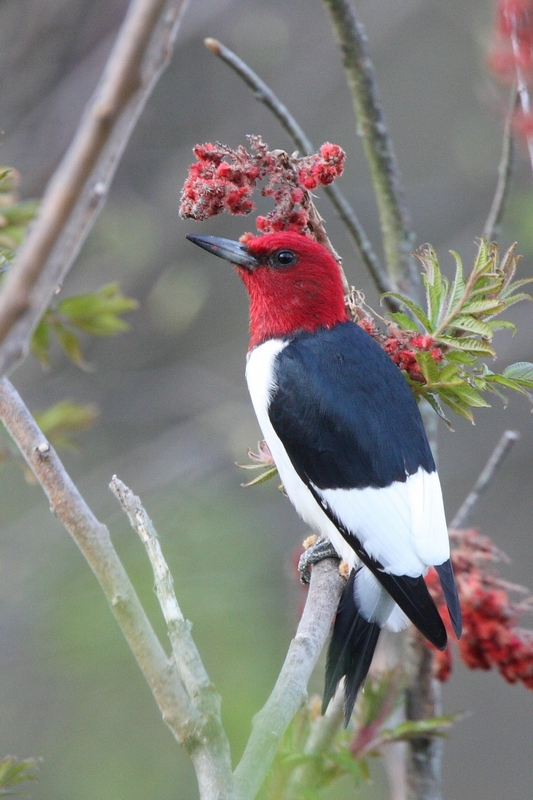
learned of some life birds you haven’t yet seen, including Sora and Pileated
Woodpecker, the bird you said you’d most love to see before departing from this
plane. I’m hoping we can make that happen for you sometime soon. It sure is a
species worth marveling over!
Unfortunately, I don’t know how many more visits like this we’ll
have. I’d love to be able to say we could collaborate on a project where I
visit, you talk, and I record... which reminds me of something from your blog. You wrote, "What I really need now is a 'mentee' or a person who wants to learn fascinating things about the many worlds to explore. I would love to share my stories with someone! Even better if they would like to help me record them!!!" Your life, your stories, and your experiences
are a colorful mural worth sharing with the world. Perhaps we will have more of these sessions. But for now, I just wanted you to know
that visiting you that day is something like how I imagine you’d feel finally
seeing that Pileated Woodpecker- it did not disappoint. One for the life list
indeed.
Update on Dr. Bob's condition: Dr. Bob was previously placed on hospice and given six months to live. However, after our meeting, he was reevaluated by his medical professionals who removed him from hospice, stating there was no indication of an imminent downturn. Dr. Bob plans to get back to his blog as soon as his eyes start feeling better, for he has many updates on what he calls the "best year ever for deck birds!"
 |
| My visit with the Setzers, Photo courtesy: Judy Setzer |